
Agency Insights
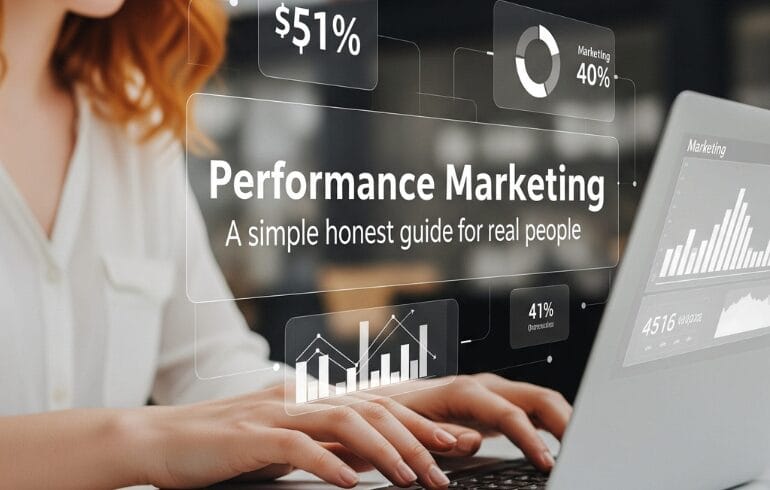
Let’s be real.
Running a business, chasing a dream, or just trying to make a few sales online? It can feel overwhelming. You put your heart into something — a product, an idea — and then you hear people say, “You just need to do some marketing.”
But… how? With what money? And where do you even start?
If you’ve ever felt lost or frustrated by all the confusing terms like “impressions,” “CPM,” or “conversion funnels,” I’ve got good news:
There’s a type of marketing that’s actually simple, actually fair, and actually works.
It’s called performance marketing.
Let’s break it down in plain English.
Performance marketing means you only pay when something real happens. Not when someone “sees” your ad. Not when someone scrolls past it. Only when someone actually:
It’s not about throwing money at ads and crossing your fingers. It’s about saying, “I’ll pay when it works.”
And that? That’s a relief — especially if you’ve ever spent money on ads that did nothing but drain your budget and your spirit.
Performance marketing is now the standard for accountable advertising worldwide. WordStream’s performance marketing guide breaks down how CPC, CPA, and ROAS benchmarks work across industries — useful reading before you set your first campaign budget. For India-specific context on how digital ad spend is shifting toward performance channels, Think with Google’s APAC marketing insights are the most current primary source available.
Why People Love It in 2026
Because it’s fair. And let’s be honest — a lot of marketing doesn’t feel that way.
Performance marketing gives you:
It’s not magic. But it’s close. Especially when you’re just starting out and every dollar matters.
Where Does It Happen?
You’ve already seen it, probably today. Here’s where performance marketing shows up:
It’s happening all around us. But the beauty is — you don’t have to be a big brand to use it.
Let’s say you make candles. Not just any candles — cozy, handmade ones that smell like fresh rain or your grandma’s cookies.
You set up a small Instagram ad. You say, “Try my handmade candles – crafted with love.”
Thousands of people scroll past. But that’s okay — you don’t pay for that.
You only pay when someone actually clicks your ad. Even better? Only when someone buys.
Imagine waking up and seeing your first sale come in from that ad. That feeling? That’s the power of performance marketing. It’s small wins, stacking up.
Start small. You don’t need to be a tech wizard. You just need to take a step.
It’s okay to make mistakes. Every marketer started exactly where you are right now.
You’re not just running ads. You’re chasing something you care about.
You’ve got a dream, a product, a service — something you made. Something real. And you want people to see it, love it, buy it. That’s not too much to ask.
Performance marketing helps you do that — in a way that’s fair, honest, and kind to your wallet.
So don’t be scared of it. Don’t think you need to be perfect. You just need to begin.
I believe in what you’re building. And you should too.
To Read more amazing content like this TAP HERE!
Performance marketing spans several channels, each suited to a different goal. Google Search Ads capture high-intent buyers actively searching for what you sell. Meta Ads (Facebook and Instagram) are unbeatable for demand generation, retargeting and visual storytelling. Google Display and YouTube build awareness at scale. LinkedIn Ads work for B2B and high-ticket services. The best campaigns use a mix: search to capture existing demand, social to create new demand, and retargeting to convert the people who didn’t buy the first time.
Performance marketing is only as good as the metrics you hold it to. The numbers that matter most are Cost Per Lead (CPL), Cost Per Acquisition (CPA), Return On Ad Spend (ROAS) and overall conversion rate. Vanity metrics like impressions and clicks are useful for diagnosis but should never be the headline goal. Before launching, define what a lead and a sale are worth to your business, then work backwards to a target CPA that keeps you profitable.
At Nurotech we follow a tested five-step process: 1) Audit and research your market, competitors and current data; 2) Build the funnel with the right audiences, offers and landing pages; 3) Create the creatives and ad copy designed to stop the scroll; 4) Launch and test multiple variations to find winners fast; and 5) Optimise weekly, cutting what loses and scaling what wins. You can see the outcomes of this approach in our case studies.
Before launching any performance marketing campaign, knowing the realistic Cost Per Lead (CPL) for your industry in India helps you set budgets that are neither reckless nor timid. The table below consolidates data from active India campaigns across Google Search Ads and Meta Ads as of 2025–2026 (sources: OryNet, OwlClaw, AdManage.ai benchmark reports).
| Industry vertical | Google Search CPL | Meta Ads CPL | Typical lead quality |
|---|---|---|---|
| Real estate | ₹800–₹2,000 | ₹150–₹700 | Google: higher intent; Meta: needs follow-up |
| Education & coaching | ₹150–₹600 | ₹80–₹400 | Both channels work; Meta volume, Google intent |
| Healthcare & clinics | ₹300–₹1,200 | ₹150–₹500 | Google captures urgent/appointment searches |
| Finance & insurance | ₹1,000–₹4,000 | ₹700–₹2,000 | High-intent; compliance rules limit creative |
| IT services & SaaS | ₹800–₹3,000 | ₹500–₹1,500 | Google leads closer to purchase; Meta for awareness |
| E-commerce (high-ticket) | ₹200–₹800 | ₹100–₹500 | Meta excels for visual/impulse products |
| Local services | ₹200–₹1,000 | ₹100–₹400 | Google "near me" leads convert fastest |
| High-ticket consulting | ₹1,500–₹5,000 | ₹800–₹3,000 | Both channels need strong landing page |
All figures are INR, exclusive of GST and ad spend. Ranges reflect campaign maturity, audience quality, and creative effectiveness — a well-optimised campaign typically sits in the lower half of the range. Sources: OryNet India CPL Report 2026, OwlClaw PPC Benchmarks India 2026.
A quick rule of thumb: if you sell something people are already searching for (a clinic appointment, a real estate inquiry, a loan), Google Search usually delivers superior ROI despite the higher CPL, because the lead is already looking for you. If you sell something people need to be shown (a new course, a lifestyle product, a subscription service), Meta's lower-CPL volume is the better starting point.
Delhi is one of India's most competitive digital advertising markets. Higher disposable income and dense business competition push CPCs and CPLs above the national average in most verticals — but the upside is proportionally higher deal values. Here is how the two dominant paid platforms compare for a Delhi-based campaign in 2026.
| Factor | Google Ads (Delhi) | Meta Ads (Delhi) |
|---|---|---|
| Average CPC | ₹30–₹120 (varies by keyword) | ₹5–₹30 (per click) |
| Average CPL — services | ₹400–₹1,500 | ₹150–₹600 |
| Average CPL — real estate | ₹1,000–₹2,500 | ₹250–₹900 |
| Average CPL — education | ₹200–₹700 | ₹100–₹350 |
| Lead intent level | High (active search) | Medium (interrupt-driven) |
| Audience targeting | Keyword + location + device | Demographics + interest + behaviour |
| Best for | High-intent services, urgent needs | Awareness, retargeting, visual products |
| Minimum test budget (Delhi) | ₹25,000–₹40,000/mo | ₹15,000–₹25,000/mo |
The honest Delhi verdict: Meta Ads will almost always deliver a cheaper CPL — but in Delhi's service and real estate markets, a Google Search lead has significantly higher closing probability. Nurotech's standard recommendation for Delhi SMEs is to start with a 60:40 Google-to-Meta budget split for service businesses, and invert that (40:60) for D2C or lifestyle brands. Retargeting (showing Meta ads to people who found you via Google) is where the two platforms compound each other most powerfully.
Client details are anonymised. Results are from a 2025–2026 Nurotech engagement.
A Delhi-based interior design company — primarily serving residential and commercial renovation clients in Delhi-NCR — came to Nurotech with a familiar problem. They were spending ₹60,000 per month on Meta Ads and getting a mix of vague inquiries and tyre-kickers. Their CPL was ₹1,200. Their sales team was spending more time qualifying than converting.
| Metric | Before | After (90 days) |
|---|---|---|
| Monthly ad spend | ₹60,000 | ₹80,000 (added Google layer) |
| Qualified leads / month | 50 | 164 |
| CPL | ₹1,200 | ₹488 |
| Lead-to-site-visit rate | 18% | 34% |
| Closed projects (quarter) | 6 | 19 |
| Estimated revenue uplift | — | +₹14L in new project bookings |
The biggest lever was not the creative — it was the qualifying form and the audience consolidation. Cheap leads that never convert are not cheap. Qualified leads that close at 12% are worth three times the CPL of unqualified leads that close at 2%.
Want results like this for your business? See how Nurotech runs performance marketing in Delhi.
You can start testing with a modest monthly budget, but the more competitive your industry, the more you need to gather enough data to optimise. A realistic starting point for most Indian SMBs is enough spend to generate at least 30 to 50 conversions a month so the platforms can learn.
Unlike SEO, performance marketing can drive leads within days of launch. The first two to four weeks are a learning and testing phase; results stabilise and improve as the campaigns are optimised.
It depends on where your customers spend time and how they buy. High-intent service businesses often start with Google Search; visual and impulse products thrive on Meta; B2B usually leans on LinkedIn and Search. We recommend the mix during your audit.
We offer flexible engagement models. Speak to our team about which structure fits your goals, and explore our performance marketing services for details.
The fastest way to waste an ad budget is to chase clicks instead of conversions. Other frequent mistakes include sending paid traffic to a slow or unfocused landing page, switching off campaigns before the platform has finished learning, targeting audiences that are too broad, and failing to set up proper conversion tracking. Without accurate tracking you are effectively flying blind, you cannot optimise what you cannot measure. We always begin an engagement by auditing tracking, pixels and analytics so every rupee of spend is accountable to a real business outcome.
Nurotech is a results-first digital marketing agency in Delhi with years of experience running profitable campaigns across Google, Meta and LinkedIn for brands in education, retail, real estate and e-commerce. We combine sharp targeting, conversion-focused creative and disciplined weekly optimisation with transparent reporting, so you always know exactly what your spend is returning. To get started, request a free strategy session through our contact page and we will map out a plan tailored to your goals.
Traditional digital marketing often focuses on activity, posting content, running brand campaigns and building presence, without tying every action to a measurable return. Performance marketing flips this: every campaign is judged purely on the results it produces, whether that is leads, sales or qualified enquiries. This accountability is exactly why growth-focused businesses in India are shifting more of their budgets toward performance channels. It does not replace brand building, which still matters for long-term trust, but it ensures the money you spend today can be traced directly to revenue. The healthiest marketing mix uses brand to create familiarity and performance to convert that familiarity into customers.
FAQs

Fill out the form or call us — let’s find where your next growth comes from.
9659 634 634 info@nurotech.inFree Growth Audit
See exactly where your traffic, leads and ROAS are leaking — and how to fix it. A senior Nurotech strategist reviews your website, SEO and ads. Free, no obligation.
No spam. We reply within 1 business day.