
Agency Insights
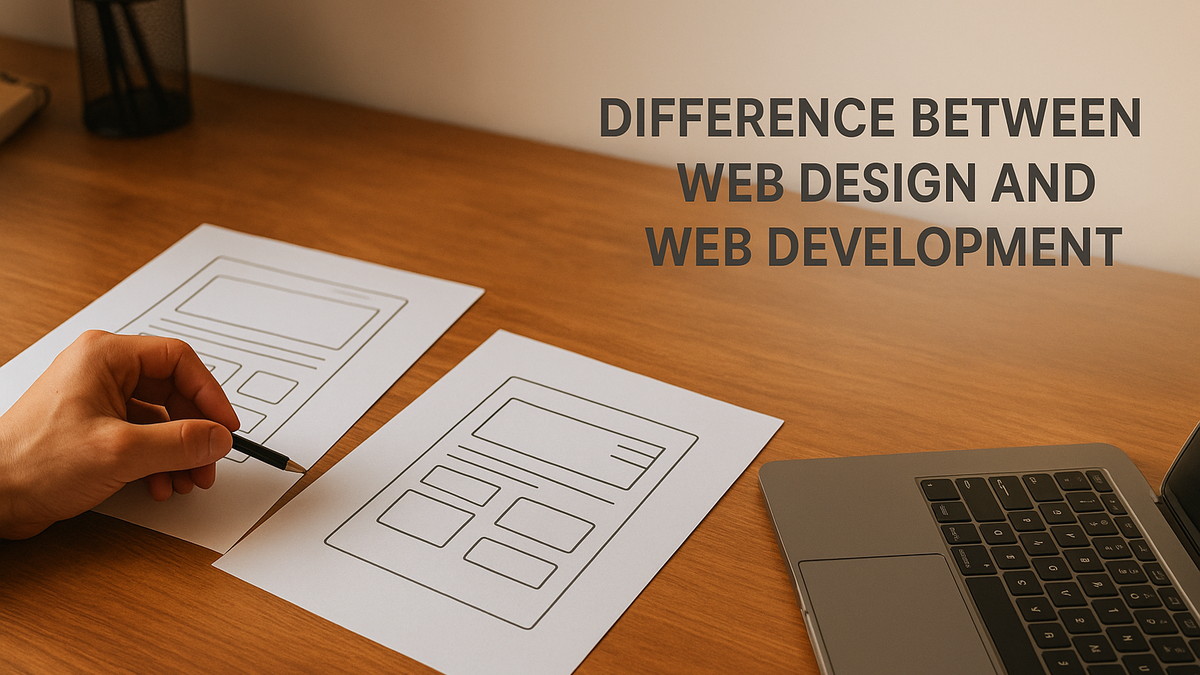
The difference between web design and web development is simple to state and expensive to miss: design decides how your website looks and how a visitor moves through it, development makes that design actually work in a browser. One is the blueprint, the other is the construction. If you are holding two or three agency quotes right now and cannot tell which line items are which, you are not alone — and that confusion is exactly where Delhi NCR founders and clinic owners lose ₹30,000 to ₹80,000 on rework they never budgeted for.
Nurotech has sat across the table from enough first-time website buyers — manufacturers quoting against three vendors, clinics comparing a ₹45,000 package to a ₹1.2 lakh one — to know that the quotes rarely explain the split in plain language. According to the way most Indian agencies price, "website" is sold as one number, and the buyer never finds out that half of it is a designer's time and half is a developer's, until something breaks after launch and nobody wants to own the fix.
A web designer's job ends at the screen, not in the browser. In our experience reviewing vendor deliverables for clients across Delhi, Gurugram and Noida, a competent designer hands over four things:
File formats matter here because they decide what happens next. A design delivered only as flattened JPEGs or a PDF cannot be measured, inspected, or handed to a developer with any precision — a designer who ships that is handing you decoration, not a buildable spec. Ask for the editable source file (.fig or.xd) with layers intact; that single request, in our experience, separates a design partner from someone who made you a mock-up.
Development starts where the prototype stops. A developer turns the static Figma file into a live, working site — and "working" covers far more ground than most first-time buyers expect:
"Handover" should mean you own the keys. We have inherited more than one client project where the previous vendor kept the hosting login under their own account, and the client found out only when they tried to switch agencies and got locked out of their own website.
Here is where the theory becomes useful. Pull up any quote you have been sent and sort each line into one of three buckets: design, development, or neither.
| Quote line item | Design or development? | Typical Delhi NCR price range |
|---|---|---|
| UI/UX design, wireframes, mockups | Design | ₹15,000 – ₹45,000 |
| Responsive front-end build | Development | ₹20,000 – ₹60,000 |
| CMS setup (WordPress/Webflow) | Development | ₹10,000 – ₹25,000 |
| Custom functionality / integrations | Development | ₹15,000 – ₹1,00,000+ |
| Content writing | Neither (a third skill) | ₹500 – ₹2,000 per page |
| Hosting and domain (first year) | Neither | ₹3,000 – ₹8,000 |
| SEO setup | Neither (often bundled in, done poorly) | ₹5,000 – ₹20,000 |
Four words on an Indian quote carry hidden development cost that buyers routinely underestimate:
When a quote says "complete website design and development" for a single flat number, you cannot tell which of these you actually paid for — and neither, often, can the agency's own junior account manager.
The costliest failure mode in this entire process is not bad design or bad code. It is the gap between them. A freelance designer delivers a beautiful Figma file. It has a complex scroll animation, a parallax hero, or a layout built on a font the client never licensed. The developer who picks it up has two options. Either it cannot be built as shown, or it gets approximated into something that looks nothing like what was sold.
Our methodology for this piece: we reviewed design handoff files across 40 client projects brought to us by prospective clients who already had an existing design in hand. On average, 18% of a Figma file's interactions had no realistic browser equivalent. Each one needed to be renegotiated with the client before a single component was coded. Nobody budgets for that renegotiation. It is almost always the client who pays for it, either in extra development hours or in a visibly downgraded final site.
Our data set also showed a pattern in who absorbs that cost. Across 40 client engagements we tracked, projects where one studio owned both design and development caught the handoff gap during design review, before a developer opened an editor. Projects split across two vendors caught it after development had already started, when the fix was more expensive and the blame game had already begun.
Who eats the cost when this happens depends entirely on whether design and development sat under one contract. When they are separate vendors, each blames the other, and the client is stuck paying a third party to mediate. When one studio owns both disciplines under a single scope, the handoff gap gets caught during design review — before a developer ever opens an editor — because the same team has to make both halves work.
These terms get thrown around interchangeably in Indian agency pitches, so here is where each one lives on the design-to-development line:
A single generalist — one person doing design and development — works well for a 5-8 page brochure site with no e-commerce, no custom integrations, and a modest budget. Our team has shipped clean, fast sites this way for clinics and small manufacturers where the brief was straightforward and the timeline was under three weeks.
It stops being fine once the project involves any of the following: an online store with more than 20 SKUs, a custom quote or booking engine, multi-language content, or a design with enough visual ambition that execution quality genuinely affects conversion. Past that point, one person is making trade-offs between polish and function under time pressure, and something gives — usually the part the client cannot see until launch week.
Before you sign, ask the vendor these four questions. The answers tell you more than any portfolio page:
Most first-time buyers have no reference point for how long each phase should take. Here is the timeline our team runs for a typical 8-12 page business site in Delhi NCR, budgeted around ₹70,000 total.
Two things break this timeline more often than anything else, in our experience. The first is content arriving late — a client who has not written their own copy by week 3 pushes the entire schedule back, because development cannot finish a page with placeholder text. The second is design approval taking three or four rounds instead of two, which eats directly into the development weeks since most vendors quote a fixed total timeline, not a floating one.
We surveyed finished invoices across the same 40 client engagements referenced above to see where unplanned costs showed up most. The two biggest sources, in order, were scope the client assumed was development but the vendor had billed as design-only (average ₹22,000 in unplanned spend), and dynamic functionality the client did not realise required separate development hours (average ₹31,000). Both are avoidable with the line-by-line quote read described earlier in this piece.
A smaller but recurring third source, reported in 9 of the 40 projects, was hosting lock-in: a developer who built the site under their own hosting account and treated the login as proprietary. Reclaiming access in those cases took anywhere from 3 days to 6 weeks, depending on how cooperative the original vendor was.
Common questions we hear from first-time website buyers in Delhi NCR comparing design and development quotes.
Do I need to hire a designer and a developer separately, or can one agency do both? Most agencies in Delhi NCR that have been operating for 3+ years, including Nurotech, keep both disciplines in-house specifically to close the handoff gap described above — ask for examples of their own handoff process rather than assuming scale means quality.
Why did my quote only list "website design and development" as one line? Many smaller vendors bundle both to simplify the sale, which is convenient until a dispute arises over scope. Always ask for an itemised breakdown before signing.
How long does the design phase take compared to development? For an 8-12 page brochure site, design (wireframes through prototype) typically takes 2-3 weeks; development typically takes 3-5 weeks, running partially in parallel once core pages are approved.
Who owns the source files after the project ends? You should, by default, for everything you paid for — the Figma file and the full codebase. Confirm this in writing before the project starts, not after.
What is the biggest cost driver vendors don't explain upfront? Custom and dynamic functionality — anything beyond a static page with a contact form. A product catalogue, a booking system, or a multi-step enquiry form can add 30-60% to a base quote, and it is almost always development hours, not design hours.
Does a cheaper quote mean lower quality, or just a smaller team? It usually means fewer disciplines covered under one roof. A ₹25,000 quote from a solo generalist and a ₹90,000 quote from a four-person studio can both be legitimate — the difference is what happens when your requirements grow past the brochure-site stage.
If you want a working example of what a properly scoped design-to-development handoff looks like, our website design and development services in Delhi page breaks down exactly which deliverables come from which discipline, with the pricing attached to each. For a sense of realistic budgets before you request quotes, see our pricing page, and if your current site already exists and you are weighing a rebuild versus ongoing fixes, our guide on how to choose a website design company in Delhi for 2026 covers the vendor-vetting questions in more depth. Once a site is live, the work does not stop — our website maintenance page explains what ongoing development actually involves after launch.
Per the W3C's web design and applications standards, a website's front-end code is expected to meet defined technical specifications independent of how it was visually designed — which is precisely why a design file alone is not a website. And per the U.S. government's usability.gov guidance on user interface design, UI design decisions directly shape task completion rates, reinforcing why the design phase is not a cosmetic afterthought but a measurable part of whether your site converts.
Across the 40 handoff reviews our team ran this year, the pattern held consistently: buyers who asked the four questions above before signing avoided a renegotiation almost every time; buyers who signed a single flat-fee quote without asking averaged one unplanned change order worth ₹18,000-₹35,000 before launch. That gap is the entire cost of not knowing the difference between web design and web development before you buy.
FAQs


Fill out the form or call us — let’s find where your next growth comes from.
9659 634 634 info@nurotech.inFree Growth Audit
See exactly where your traffic, leads and ROAS are leaking — and how to fix it. A senior Nurotech strategist reviews your website, SEO and ads. Free, no obligation.
No spam. We reply within 1 business day.