
Agency Insights
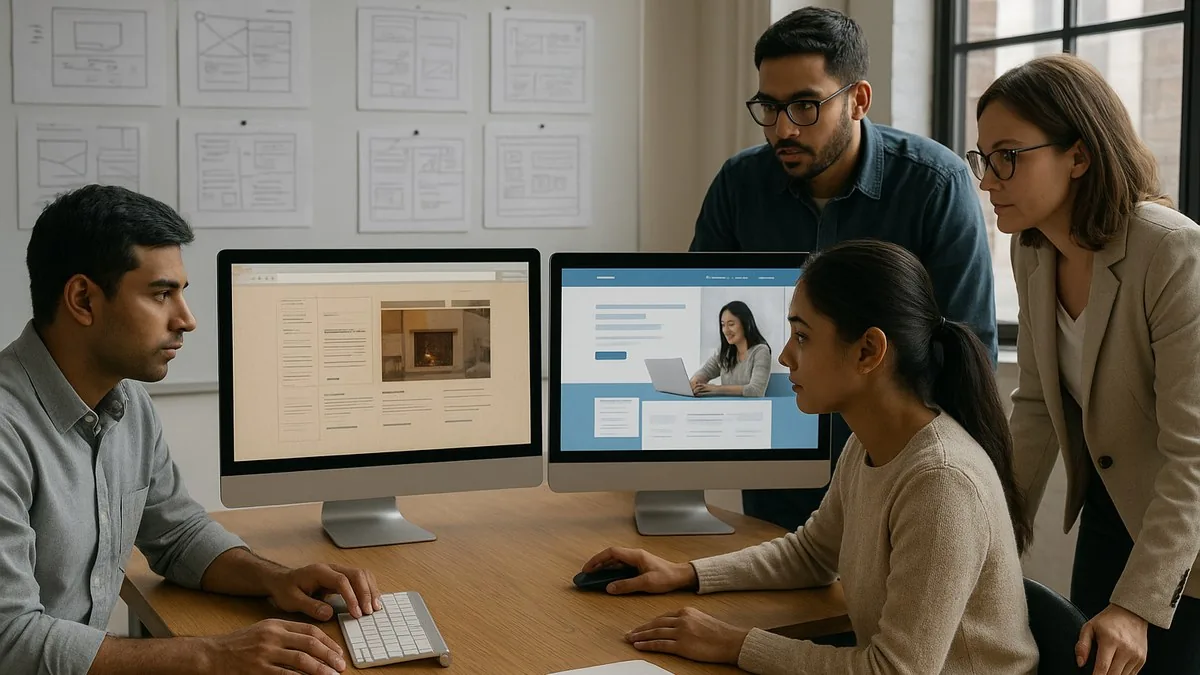
Most business owners in Delhi do not wake up one morning and decide "I need a website redesign." It happens gradually. Leads slow down, someone mentions the site looks dated during a sales call, or a competitor's new website comes up during a Google search and yours does not even show on the first page anymore. By the time the decision finally gets made, the site has usually been quietly losing business for six to twelve months.
We have rebuilt websites for clients across Nehru Place, Karol Bagh, Lajpat Nagar, and Gurugram since 2016, and the pattern repeats almost every time: the warning signs were visible for months before anyone acted on them. This guide lays out the seven signs that actually matter, based on what we see when we audit a site before quoting a redesign, not generic checklist filler you can find on any agency blog.
If you want the shortlist of questions to ask before hiring anyone for this work, we have a separate buyer's guide on how to choose a website design company in Delhi. This article is narrower: it is about deciding whether you need the work done at all, and what kind of redesign you actually need.
Before the seven signs, one clarification that saves clients a lot of wasted money: a "redesign" can mean three very different projects.
A lot of the "redesign" work sold in Delhi's website market is actually just sign #1 dressed up as a full solution. It photographs well in a proposal deck and it is quick to deliver, so it is tempting to sell. But if your real problem is site speed or lead conversion, a cosmetic refresh will not move the number that matters. Keep this distinction in mind as you read the signs below, because we will flag which type of redesign each sign usually calls for.
If you have Google Analytics connected (and if you do not, that is itself a sign worth fixing), check bounce rate and average session duration over the last 12 months. A steadily climbing bounce rate, especially on mobile, usually means one of three things: the page is loading too slowly, the layout looks broken or dated on the visitor's device, or the content does not answer what they searched for within the first few seconds.
Google's own research found that as page load time goes from 1 second to 5 seconds, the probability of a mobile visitor bouncing increases by 90 percent, and 53 percent of mobile visits are abandoned if a page takes longer than 3 seconds to load (Think with Google). We have pulled Core Web Vitals reports for prospective clients in Delhi where the site took 6 to 9 seconds to become interactive on a mid-range Android phone over 4G. On those numbers, over half your mobile traffic never even sees your homepage properly.
What this sign usually means: a technical rebuild, not a cosmetic one. Speed is architecture, not paint.
Delhi and NCR are overwhelmingly mobile-first markets. Across most of our client accounts, 65 to 78 percent of organic traffic now arrives on a phone. If your site was built even five years ago and simply "made responsive" later by squeezing a desktop layout into a smaller viewport, visitors feel it immediately: buttons too close together, text that needs zooming, forms that are painful to fill on a touchscreen, images that do not crop sensibly.
Google has used mobile-first indexing to crawl and rank sites based on the mobile version since 2019. If your mobile experience is worse than your desktop one, you are not just losing conversions, you are also handing Google's crawler a worse version of your business to rank.
What this sign usually means: UX and content rebuild at minimum; a full rebuild if the underlying framework cannot support a true mobile-first layout.
This is the sign clients notice first, even though it is rarely the most urgent one. Visual trends in web design shift roughly every 3 to 5 years: heavy drop shadows and skeuomorphic buttons gave way to flat design, which gave way to the current preference for generous whitespace, bold typography, and motion-based micro-interactions.
A dated design is not just an aesthetics problem. Stanford's Web Credibility research found that 46.1 percent of consumers rank a website's visual design as the number one criterion for judging a company's credibility (Stanford Persuasive Technology Lab). In a B2B context in Delhi, where a prospect is deciding whether to trust you with a six or seven-figure contract, a site that looks unmaintained sends a signal about how you run the rest of your business, whether that is fair or not.
What this sign usually means: cosmetic refresh can help, but combine it with a content audit, because a dated design and dated copy usually travel together.
We regularly meet business owners who are still paying a freelance developer a monthly retainer just to change a phone number or add a new product photo. If every content change requires a developer, three things are true: your CMS setup is broken or missing entirely, you are paying an ongoing tax on basic marketing agility, and your site content is going stale because updates are annoying and expensive.
A properly built WordPress, Shopify, or Astro-based site should let a non-technical team member update prices, add a blog post, or swap a banner image in minutes, not days. If your current site cannot do that, the redesign conversation is really a "rebuild the foundation" conversation.
What this sign usually means: full technical rebuild with a proper CMS or headless architecture.
Businesses evolve faster than their websites. We have taken over accounts where the homepage still led with a service line the client stopped offering two years ago, while their current highest-margin service was buried three clicks deep or missing entirely. If a first-time visitor cannot tell, within 5 seconds of landing, what you do and who you do it for, your website is actively working against your sales team, not with it.
This mismatch also hurts SEO. Search engines match query intent to page content. If your site's structure and copy describe a business you used to run, you will keep losing rankings to competitors whose sites accurately describe what buyers are searching for today.
What this sign usually means: UX and content rebuild, built around your current service architecture and information architecture (IA), not the old one.
This one shows up constantly in our discovery calls. A client tells us, almost embarrassed, "I searched our category and saw [competitor's] site come up, and it just looked so much more professional than ours." That instinct is usually correct, and it is worth taking seriously rather than dismissing as vanity.
We track competitor keyword and content positioning for clients across categories in Delhi NCR as part of our own SEO research process, and the pattern is consistent: the sites ranking on page one for competitive local terms almost always have modern, fast, well-structured websites behind them. Design quality alone will not win rankings, but it correlates strongly with the sites that do, because the same investment in the business usually shows up in both areas.
What this sign usually means: depends on the gap. A genuinely underbuilt site relative to competitors usually needs the full package: rebuild plus content plus technical SEO, not just a fresh coat of paint. Our SEO services in Delhi work covers the ranking side of this once the site foundation is fixed.
This is the most financially urgent sign, and the one that gets missed most often because owners look at traffic numbers, see they are stable or growing, and assume the website is "fine." Traffic and conversion are two separate problems. A site can pull in visitors reliably through SEO or ads and still fail to turn them into leads or sales because of friction in the experience: a confusing form, a missing trust signal, no clear call to action above the fold, or a checkout flow with too many steps.
If your cost per lead has been quietly climbing while your traffic has stayed flat, the honest read is usually a conversion problem on the site itself, not a traffic acquisition problem. Redesigning without first diagnosing where visitors are dropping off is how businesses spend lakhs on a beautiful new site that converts at the same rate as the old one.
What this sign usually means: UX rebuild driven by conversion rate optimisation (CRO) analysis, not just a visual refresh. This is the sign most worth doing a proper audit before committing to a scope.
A useful rule from our own client work: one or two signs on their own are usually fixable with targeted improvements rather than a full redesign. Slow load time alone might just need image compression, caching, and a hosting upgrade. A dated look alone might just need a visual refresh layered onto the existing structure.
Three or more signs together, especially if they include falling conversion rate, poor mobile experience, and an inability to update content independently, is a strong indicator that patching individual problems will cost close to as much as a proper redesign, and will still leave you with the underlying architecture that caused the problems in the first place.
If you are unsure which category you fall into, an honest technical and UX audit before any redesign work begins is the right first step, and any agency worth hiring should be willing to do that audit and tell you honestly if you do not need a full rebuild.
Pricing varies widely by scope, and we have written a full breakdown separately in our guide to website costs in India, but as a general orientation for the Delhi market in 2026:
Any quote significantly below these ranges for a genuine rebuild is usually either a template-only job with no real content or SEO work, or it is being subsidised by ongoing dependency, meaning you will pay again later every time you need a change made. Any quote significantly above without a clear scope breakdown is worth pushing back on for specifics.
We are a Delhi-based digital marketing and web development agency operating under Yogya Infomedia Limited since 2016. Redesigns are one of the most common projects we take on, precisely because so many businesses in Delhi NCR are operating on sites built five, seven, or ten years ago that have simply never been revisited.
A few things we hold ourselves to on every redesign engagement:
Our website redesign and design services are outlined on our website redesign services page, and our broader web design and development work is covered on our main services page.
If two or more of the seven signs above sound familiar, the most useful next step is not to commission a redesign immediately, it is to get an honest audit of what is actually wrong: speed, structure, content, or conversion, so the redesign scope matches the real problem instead of guessing.
We offer this audit as the starting point for every redesign conversation we have with a new client. You can get in touch with our team to have a Nurotech strategist walk through your current site and tell you plainly which of these seven signs apply, and what fixing them would realistically cost and take.
A website is not a one-time expense, it is infrastructure for every other marketing channel you run: your ads, your SEO, your referrals, and your sales calls all eventually send someone back to this same site. Getting the redesign decision right the first time is worth the extra week spent auditing before you spend the budget building.
Because "redesign" gets used loosely, here is the framework we actually apply internally when we scope a project for a Delhi client, roughly in the order we check things:
Each layer is progressively more expensive to fix and more foundational. Fixing visual design on top of a slow, poorly structured site is like repainting a wall with a cracked foundation. It looks better in the photos, but the underlying problem is still there, now hidden.
We see the same handful of mistakes repeat across almost every redesign project we take over from a previous agency or a DIY attempt.
Redesigning without a redirect plan. When URLs change during a rebuild, every old page that had earned rankings and backlinks needs a 301 redirect to its new equivalent. Skip this and you lose months of accumulated SEO equity overnight. We have inherited client accounts where a previous redesign wiped out 40 percent of organic traffic in the weeks after launch simply because nobody mapped old URLs to new ones.
Treating the redesign as a one-time project instead of a platform decision. The CMS, hosting, and codebase you choose now will determine how easy or expensive every future change is for the next several years. Choosing based purely on upfront cost, without asking who maintains it and how, is a common regret we hear from clients on their second redesign.
Skipping analytics setup on the new site. We have seen businesses launch a new site and only realise weeks later that conversion tracking was never properly reconnected, meaning they are flying blind on exactly the metrics that justified the redesign in the first place.
Letting design happen before strategy. Choosing colours and layouts before deciding on information architecture, target keywords, and conversion goals produces a site that looks good in a portfolio but is not built around how visitors actually use it or how search engines crawl it.
Written by Rajeev Gupta, Founder of Nurotech, a Delhi-based digital marketing and web development agency established in 2016 under Yogya Infomedia Limited. Rajeev has led website and performance marketing projects delivering outcomes including 600% average revenue growth and 9x ROAS for e-commerce and service clients across India and the UAE.
FAQs
Fill out the form or call us — let’s find where your next growth comes from.
9659 634 634 info@nurotech.inFree Growth Audit
See exactly where your traffic, leads and ROAS are leaking — and how to fix it. A senior Nurotech strategist reviews your website, SEO and ads. Free, no obligation.
No spam. We reply within 1 business day.