
Agency Insights
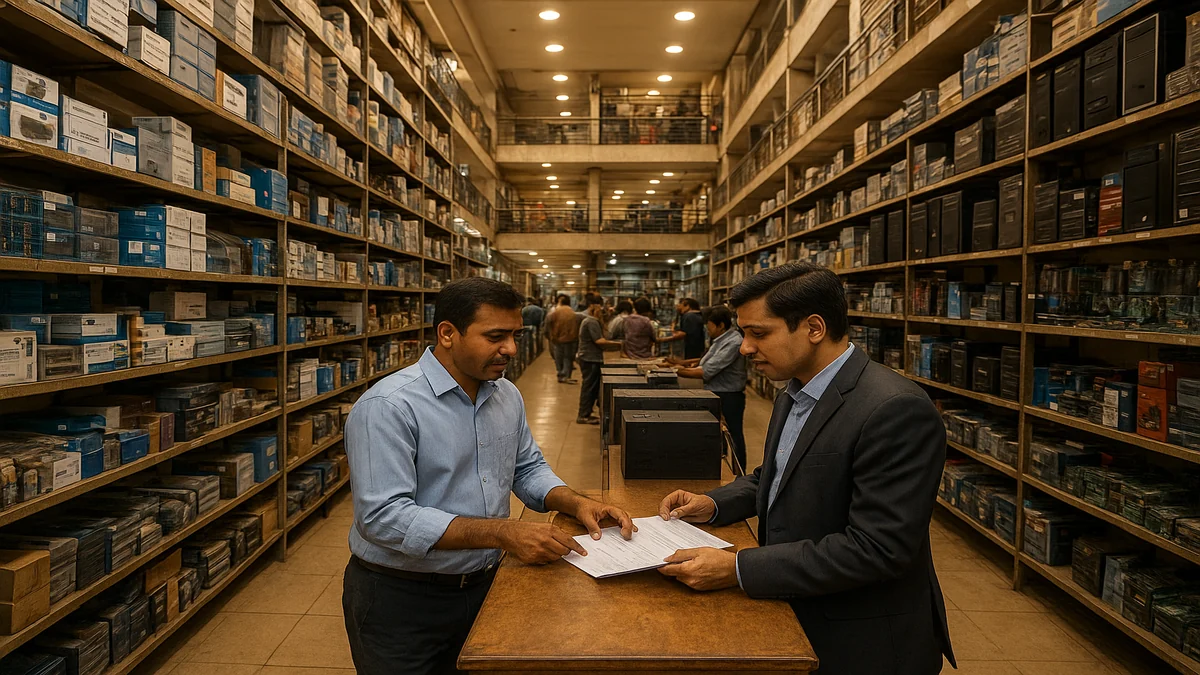
If you sell laptops, servers, networking gear, CCTV systems, or electronic components out of a shop or office in Nehru Place, most SEO advice you'll find online is written for the wrong kind of business. It assumes a walk-in retail customer who searches, clicks a Google Maps pin, and shows up in twenty minutes. That model works for a restaurant or a salon. It does not describe how a purchase manager at a mid-size company in Okhla, or a systems integrator bidding on a corporate AMC, actually finds and vets a hardware supplier in Nehru Place.
Nehru Place is India's largest IT hardware and electronics trading hub outside a handful of comparable markets, with an estimated 2,500+ shops and offices spanning computer hardware, networking equipment, telecom accessories, CCTV and security systems, electronic components, and IT services across its commercial towers and market blocks. It is also one of the most competitive and confusing local-SEO environments in Delhi — because the buyers searching for you are not consumers, they are procurement decision-makers, and the search behaviour, trust signals, and conversion path for procurement are fundamentally different from retail local SEO.
This guide is written specifically for Nehru Place traders — hardware resellers, distributors, systems integrators, and electronics wholesalers — and covers what actually moves rankings and generates enquiries in a B2B-heavy local commercial market, as opposed to the generic "get more Google reviews" advice that dominates local SEO content (for consumer-facing shops in the market, our standard local SEO for small businesses in Delhi approach still applies).
Standard local SEO frameworks are built around the "near me" consumer journey: someone searches "electronics repair near me," sees three Google Business Profile results in the Map Pack, picks the closest one with good reviews, and visits within the hour. Google's own local-search guidance is written largely around this pattern — proximity, prominence, and relevance to a nearby searcher. Google's official guide to ranking in local search results is a good primer on the mechanics, but it does not address how B2B procurement search differs.
Nehru Place buyers behave differently in three specific ways:
1. The search happens before the visit, sometimes days or weeks before. A company sourcing 40 laptops for a new office, or an AMC contract for server maintenance, does not walk into Nehru Place on a whim. Someone in procurement searches, shortlists 3-5 vendors online, checks pricing/catalogue/reputation, and only then visits or calls. If your online presence doesn't survive that shortlisting stage, the in-person visit never happens.
2. Trust signals are different. A consumer trusts a 4.5-star rating and photos of a clean shopfront. A procurement buyer wants to see: what brands you're an authorised dealer or reseller for, whether you handle bulk/corporate orders, whether you offer GST invoicing and AMC/warranty support, and whether other businesses (not just individual reviewers) have used you. Generic Google reviews ("great service, fast delivery") don't answer any of these questions.
3. The buying unit is bigger than one search. A single enquiry can be for ₹50,000 or ₹5,00,000 worth of hardware. That changes the economics of SEO completely — you don't need thousands of visitors, you need the right 20-30 qualified enquiries a month landing on a page that actually demonstrates you can fulfil a corporate order, not just sell one item over the counter.
This is why "SEO company near Nehru Place" style directory listings and template local-SEO checklists consistently underperform for hardware and electronics traders here — they're solving the wrong problem.
Before building any SEO strategy, it's worth separating the three distinct search intents that overlap in this market, because each needs a different page and different content:
| Search Intent | Example Queries | What the Buyer Wants to See |
|---|---|---|
| Brand/product specific | "HP laptop dealer Nehru Place", "CCTV camera wholesale Nehru Place" | Brand authorisation, stock availability, bulk pricing |
| Category/service | "computer hardware shop Nehru Place", "networking equipment supplier Delhi" | Full catalogue breadth, service capability, corporate order handling |
| Trust/comparison | "genuine laptop dealer Nehru Place", "best IT hardware shop Nehru Place reviews" | Third-party proof — reviews, years in business, client list, warranty terms |
Most Nehru Place traders only have a Google Business Profile and maybe a Facebook page addressing the first intent. Almost none have content addressing the second and third — which is precisely where the SEO opportunity sits, because there is close to zero dedicated, well-optimised content targeting this market. In our own keyword research on Nehru Place-related local search terms, we found near-zero existing pages built specifically for this hub, despite consistent search demand — a gap most Delhi agencies haven't bothered to fill because it requires understanding a trading market, not just running a generic local SEO checklist.
Most guides tell you to "complete your Google Business Profile." That's necessary but insufficient for a trading business. The specifics that matter for Nehru Place:
If your website (or landing page, if you don't have a full site) is a product catalogue with no context, you're leaving the highest-value search intent — corporate/bulk buyers — completely unaddressed. The single highest-leverage content addition for a Nehru Place trader is a dedicated "Corporate & Bulk Orders" page or section covering:
This single addition does more for qualified-lead generation than a dozen generic "top electronics shops in Delhi" blog mentions, because it directly answers the questions that convert a procurement-stage searcher into an enquiry.
Review volume still matters for local ranking — proximity, relevance, and prominence (which reviews strongly influence) remain Google's stated core local ranking factors. But for a Nehru Place trader, the content of reviews matters more than the star average alone. A review that says "ordered 15 laptops for our office, smooth GST billing, delivered on time" is worth significantly more — to both ranking signals and to a human reading it before ordering — than five generic five-star reviews with no detail.
Practical approach: when following up with corporate clients after a bulk order, ask specifically for a review mentioning what they bought and how the process went, rather than a generic star rating request. Over 3-6 months, this builds a review profile that reads as a B2B track record instead of a retail rating.
Nehru Place's near-total absence of structured, well-optimised content isn't just a Google-ranking gap — it's also why almost no Nehru Place-specific hardware or electronics trader currently shows up when a buyer asks an AI assistant like ChatGPT, Perplexity, or Gemini something like "who sells networking equipment in bulk in Delhi." These tools synthesise answers from content that is specific, structured, and directly answers a real question — generic shop listings and thin product pages rarely qualify. A dedicated page with Product, LocalBusiness, and FAQPage schema markup, answering the exact procurement questions above, is far more likely to be surfaced by both traditional search and AI-generated answers. We cover this in more depth in our overview of generative engine optimization — for a market as commoditised online as Nehru Place, this is currently an almost uncontested opportunity.
Rather than a generic "Top 10 Electronics Shops in Nehru Place" listicle (the dominant format currently occupying this search space, none of it written with any real authority), the content that ranks and converts addresses genuine buyer questions:
This kind of content builds topical authority for the trading-hub keyword cluster while directly serving the buyer's actual decision-making process — which is what both Google's helpful-content systems and AI answer engines are increasingly built to reward. Google's guidance on creating helpful, reliable content is explicit that content written to genuinely help the reader outperforms content written primarily to rank — and in a market this saturated with thin listicles, that gap is unusually wide open.
Days 1-15 — Foundation: - Rewrite Google Business Profile categories, services, and Q&A for B2B/corporate intent - Add operational-scale photos (warehouse, staff, delivery) - Audit existing reviews and identify 5-10 recent corporate clients to request detailed reviews from
Days 16-45 — Core content: - Build (or add to an existing site) a Corporate & Bulk Orders page with the specifics listed above - Add LocalBusiness + Product + FAQPage schema markup - Publish one authority piece addressing a genuine buyer concern (authorised-dealer verification, AMC vs warranty, or similar)
Days 46-90 — Compounding: - Continue collecting detail-rich B2B reviews monthly - Add a second and third content piece targeting adjacent procurement questions - Monitor Google Search Console and AI-citation visibility (asking ChatGPT/Perplexity your target queries directly is a legitimate, free way to track this) and iterate on whichever page is closest to ranking
This sequence is deliberately front-loaded on trust and buyer-intent content rather than volume of pages, because in a B2B-heavy market like Nehru Place, twenty qualified enquiries from procurement-ready buyers outperform two hundred visits from people who were never going to place a bulk order.
Most of Delhi's local SEO competition is retail-consumer-shaped, and most agencies — including many operating "SEO company in Delhi" or generic local SEO packages — apply the same consumer playbook everywhere without adjusting for market type. Nehru Place is one of the clearest examples in Delhi NCR of a hyperlocal market where that mismatch actively costs traders enquiries: the shops investing in generic reviews-and-citations SEO are optimising for a buyer journey that doesn't match how their actual customers search and decide.
We've built this same B2B-adjusted approach for clients across Delhi NCR's commercial hubs — our broader work on local SEO for small businesses in Delhi and our experience with East Delhi's commercial and trading businesses both draw on the same principle: local SEO strategy has to match the actual buying behaviour of the market, not a template.
If you run an IT hardware, electronics, networking, or component trading business in Nehru Place and want a straight assessment of where your current online presence stands against this framework, get in touch with Nurotech — we'll tell you honestly what's worth fixing first.
FAQs


Fill out the form or call us — let’s find where your next growth comes from.
9659 634 634 info@nurotech.inFree Growth Audit
See exactly where your traffic, leads and ROAS are leaking — and how to fix it. A senior Nurotech strategist reviews your website, SEO and ads. Free, no obligation.
No spam. We reply within 1 business day.