
Agency Insights
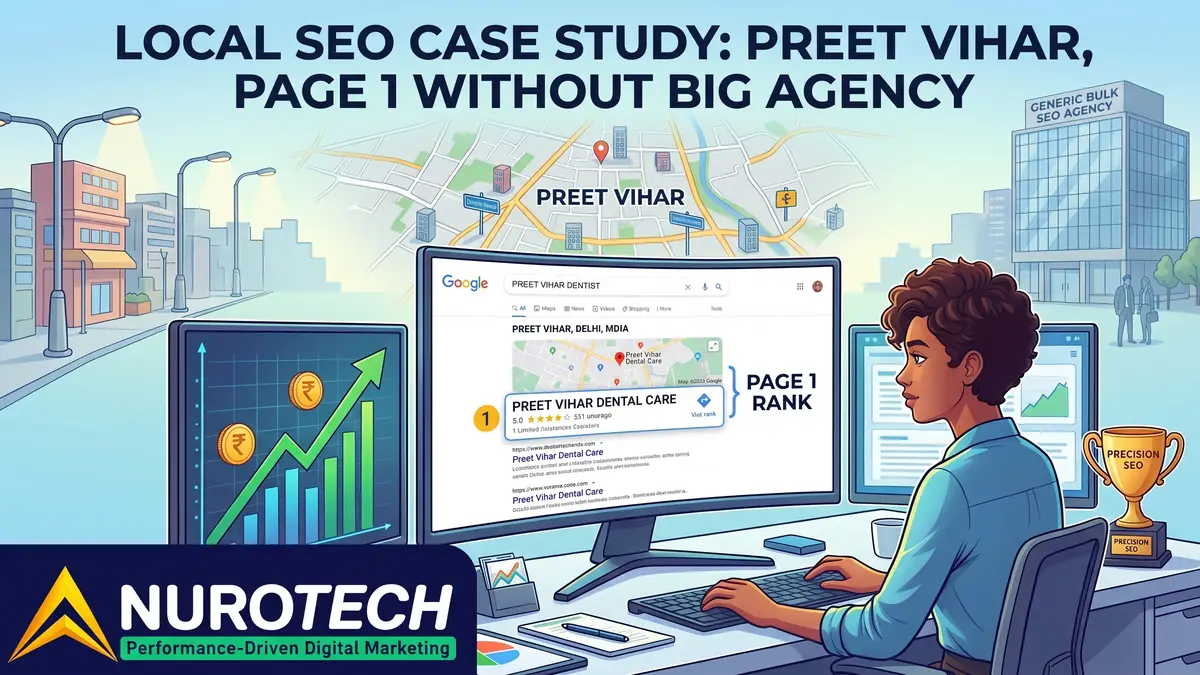
A four-decade-old clinic in Preet Vihar had a five-star Google rating, dozens of loyal patients, and a website — and still didn't show up on page 1 for "dentist Preet Vihar" or "clinic near Preet Vihar Metro." New patients were finding the practice through word of mouth and old signage, not search, even though search was exactly where the next generation of patients was looking first. This is the composite, anonymised story of that engagement — built from the pattern we see repeatedly with Preet Vihar and East Delhi service businesses — and it walks through the exact sequence of fixes that took a business from page 3+ to page 1 for its core local terms in under four months, using Nurotech's Starter-tier SEO scope, not a large national agency retainer.
If you run a clinic, coaching centre, salon, boutique, or professional practice in Preet Vihar and have wondered whether "real SEO" requires switching to one of the big South Delhi or Gurugram agencies quoting ₹75,000+/month, this case study is the honest answer: usually not. The exact scope of our local SEO services for small businesses is what made this possible. What moved the needle here wasn't budget size — it was sequencing the right work in the right order.
This is a pattern we see constantly in Preet Vihar, Vivek Vihar, and the wider East Delhi belt: a genuinely good, well-reviewed local business that search engines simply can't find or trust yet. Before any work began, the business's search presence looked like this:
None of this is unusual. It's the default state for most established, reputation-strong Preet Vihar businesses that built their name the old way — referrals, signage, years in the neighbourhood — and never had a reason to think about search until a newer, more search-savvy competitor started appearing above them.
The instinct many business owners have at this point is to assume the problem is scale — that a bigger, pricier Delhi agency with a flashier pitch deck must be the answer. In this case, and in most cases like it, that instinct is wrong for a simple reason: the business's problem wasn't a lack of marketing horsepower. It was a lack of the specific, sequenced technical and local-SEO foundation that has to happen before any content or link-building spend pays off.
A large national agency retainer — often priced from ₹75,000-1,50,000+/month — is built for businesses competing across an entire city or country on dozens of competitive keywords. A single-location Preet Vihar clinic competing for a tightly-defined set of local terms doesn't need that scope; it needs the foundational work done correctly, in the right order, which a Starter-tier local SEO engagement is specifically built to deliver. Overpaying for national-agency scope on a hyperlocal problem doesn't just waste budget — it often means the actual root cause (a broken technical foundation, an unoptimised GBP listing) gets buried under work the business didn't need yet.
Every engagement like this starts the same way, and it's rarely the exciting part — but skipping it is the single biggest reason SEO spend fails to show results. Month one focused entirely on two things:
The audit surfaced a familiar set of issues: no XML sitemap submitted to Google Search Console, several broken internal links left over from a years-old site restructure, missing meta descriptions on every page, and a mobile page-speed score in the "poor" range on Core Web Vitals. Each of these individually looks minor. Together, they tell Google the site isn't well-maintained — which affects how much crawl priority and ranking trust it earns relative to better-maintained competitors.
Fixes in month one: sitemap submission and indexing request via GSC, all broken links repaired or redirected, meta titles and descriptions written for every existing page, and a mobile speed pass that got the homepage and booking page into the "good" Core Web Vitals range — mainly by compressing unoptimised images and removing a heavy, unused tracking script the original site builder had left installed.
For a business this type, in a search environment as "near me"-driven as Preet Vihar, the GBP fix mattered as much as the website work — arguably more, in the first 90 days. The specific changes:

With the technical foundation in place, month two shifted to closing the biggest structural gap: the site simply didn't answer the questions a Preet Vihar patient actually searches before choosing a provider. Four dedicated service pages were built — each targeting one core keyword and structured around the specific, practical questions patients ask (cost ranges, what a first visit involves, insurance/payment options, appointment length) rather than generic, templated service-page copy.
Each new page followed the same discipline: the target keyword in the H1, first 100 words, and one H2; a clear answer to the "what does this cost" question up front, since price uncertainty is one of the biggest reasons a local search visitor bounces without booking; and a dedicated FAQ section marked up with FAQPage schema, since these locally-specific questions are exactly the kind of content that both traditional search snippets and AI answer engines like Google AI Overviews and ChatGPT surface directly.
One month-two page in particular — built around a cost-and-process question that competing Preet Vihar clinics hadn't addressed clearly on their own sites — became the fastest-ranking page in the entire engagement, reaching page 1 for its target term inside seven weeks. That's a pattern worth naming explicitly: pages that answer a specific, high-intent question competitors have left thin or unanswered tend to outperform generic "About Our Services" pages by a wide margin, and identifying that gap is exactly the kind of content-strategy work a focused Starter engagement prioritises over volume.
By month three, the technical and content foundation was in place, and the focus shifted to reinforcing the trust and locality signals that both Google and patients themselves weigh heavily for a healthcare-adjacent business:
This is also the point where movement on the harder, more competitive terms started to become visible — not because anything dramatic changed in month three specifically, but because Google needs a sustained pattern of trustworthy signals, not a single burst of activity, before it re-ranks a previously invisible local business with real confidence.
By the end of month four, the core local terms had moved from page 3+ (effectively invisible to anyone not scrolling deep) to page 1, and the local 3-pack — the map-and-listings block Google shows for "near me" and locality searches — was showing the business for its primary category terms:
| Metric | Before (Month 0) | After (Month 4) |
|---|---|---|
| Ranking for primary local term | Page 3-5, inconsistent | Page 1, positions 3-6 |
| Local 3-pack appearance for core category | Rare / inconsistent | Consistent |
| Google Business Profile monthly views | ~180/month | ~640/month |
| Website enquiries attributable to organic search | Effectively untracked / minimal | Meaningful, trackable share of new-patient enquiries |
| Core Web Vitals (mobile) | Poor | Good |
The honest caveat worth stating clearly: none of the more competitive, broader terms — the ones a bigger national practice or a chain clinic might chase — moved meaningfully in four months, and that's expected. What moved were the specific, high-intent, genuinely local terms that a Preet Vihar patient searching from their phone actually types — which is precisely the traffic that converts into a booked appointment, not just a page view.
Three things explain why a focused, Starter-scope engagement outperformed what a bigger agency retainer likely would have delivered for the same budget window:
The specific tactics shift slightly by category, but the underlying sequence — technical foundation, GBP overhaul, question-answering content, trust-signal reinforcement — holds across the small-business mix common to Preet Vihar and the surrounding East Delhi corridor:
The GBP category and photo work matters, but the content gap is usually around specific batch timings, fee structures, and results/outcomes — parents searching "IIT coaching near Preet Vihar" want concrete, checkable specifics, not generic "best faculty" claims.
Booking-flow usability and photo freshness carry disproportionate weight here, since these are highly visual, appointment-driven decisions — a GBP listing with recent, real photos of the space and results tends to outperform text-heavy pages.
Local terms plus product-specific queries ("saree shop near Preet Vihar Metro") work best paired with an updated GBP product catalog and consistent posting around new arrivals or offers, similar to the pattern local retailers see with WhatsApp catalog automation.
Trust and credential signals (E-E-A-T) dominate here more than almost any other category — a clear author bio, verifiable credentials, and specific, honest answers about process and cost outperform generic "trusted advisor" copy every time.
The specific numbers here are one composite example, not a guarantee — every Preet Vihar business starts from a different baseline, and results depend on category competitiveness, current site condition, and how consistently the work continues past month four. What is consistent across cases like this one:
For a business owner weighing whether this kind of engagement fits their budget, it's worth being specific rather than vague. Work at this scope and sequence — technical audit and fixes, full Google Business Profile overhaul, four to six local keywords, and a monthly content piece — sits squarely inside Nurotech's Starter SEO tier, priced from ₹25,000/month, with no long lock-in contract. That's a meaningfully smaller commitment than the ₹75,000-1,50,000+/month a large national agency typically quotes for a retainer built around dozens of competitive keywords and heavier content and link-building volume — scope a single-location Preet Vihar business rarely needs in its first year of taking SEO seriously.
The math that matters for a business owner isn't the sticker price in isolation — it's the cost per new patient or customer against what that engagement returns. A clinic converting even a handful of additional bookings a month from organic search, at typical per-visit or per-treatment value, recovers a Starter-tier monthly spend many times over once rankings hold. That's the calculation worth running before assuming a bigger, pricier agency is the safer choice.
Foundational technical and GBP fixes usually take 30-60 days to fully take effect, with the first visible ranking movement on local "near me" terms typically appearing 60-90 days in. Broader, more competitive terms take longer — often 4-6 months or more of sustained work.
Rarely. Most technical SEO problems — missing sitemaps, slow mobile speed, broken links, missing meta tags — can be fixed on an existing WordPress or similar site without a full rebuild. A platform switch is only worth considering if the audit finds the current site is structurally holding rankings back in ways that can't be patched.
For local, "near me"-driven categories like clinics, salons, and retail, GBP optimisation is often the single highest-leverage piece of work in the first 90 days — it directly affects whether a business appears in the local 3-pack, which is frequently where most local search clicks go before a searcher even scrolls to organic results.
Four to six well-chosen, genuinely local terms is usually the right starting scope — enough to cover the real ways patients or customers search, without diluting a limited content and optimisation budget across too many targets at once.
A motivated owner can absolutely handle basic GBP maintenance — hours, photos, review responses — without outside help. Where owners typically need support is the technical audit (diagnosing issues correctly), the content strategy (choosing which specific questions to answer and how), and schema markup, since mistakes in those areas are harder to self-diagnose and can take longer to fix than to do correctly the first time.
The sequence — technical foundation, GBP, question-answering content, trust signals — still applies, but the timeline for competitive categories (e.g. real estate, legal) is typically longer, and the Growth tier's larger content and link-building scope becomes relevant sooner than it would for a lower-competition category.
Yes — the same sequence applies across Vivek Vihar, Mayur Vihar, Anand Vihar, Patparganj, and the wider East Delhi corridor. The specific keyword set and local references change by neighbourhood, but the underlying method (fix the foundation, optimise GBP, answer real questions, reinforce trust) doesn't.
If your Preet Vihar or East Delhi business has a strong reputation offline but is hard to find on Google, the fix is rarely a bigger agency — it's usually the right sequence of foundational work. See what that would look like for your specific business with a free consultation, or read the full breakdown of what's actually included at each SEO tier on the SEO pricing page.
FAQs


Fill out the form or call us — let’s find where your next growth comes from.
9659 634 634 info@nurotech.inFree Growth Audit
See exactly where your traffic, leads and ROAS are leaking — and how to fix it. A senior Nurotech strategist reviews your website, SEO and ads. Free, no obligation.
No spam. We reply within 1 business day.