
Agency Insights
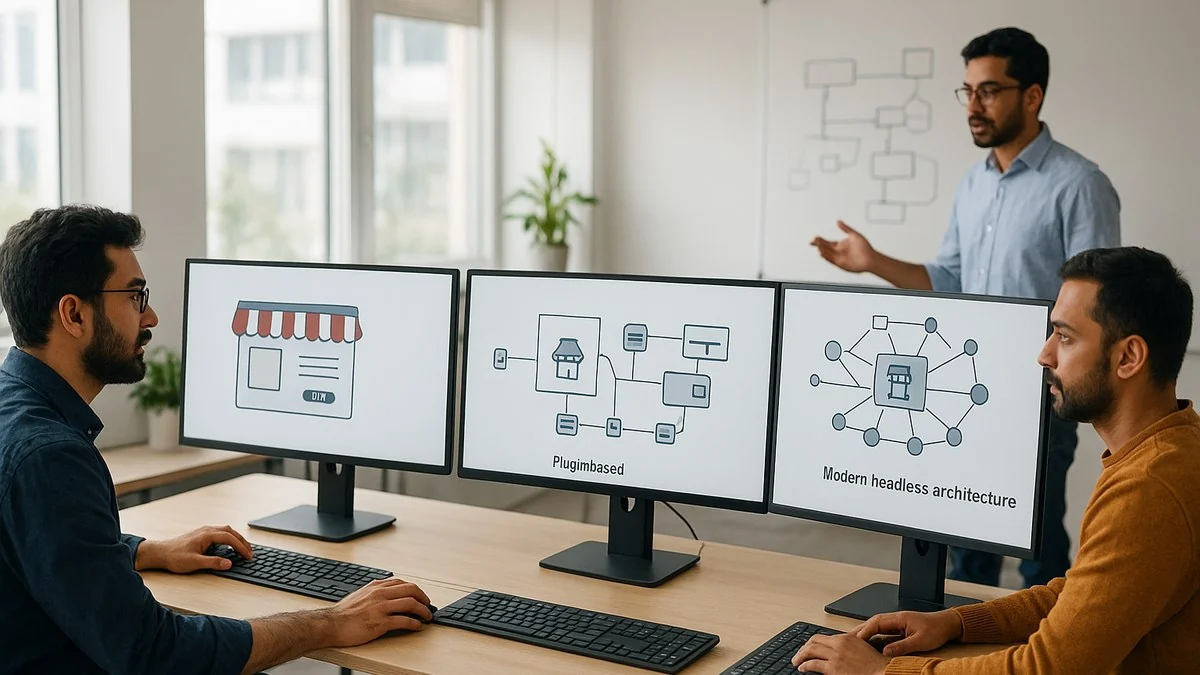
There is no single winner. Shopify wins for pre-launch and early-stage brands that need to sell this month. WooCommerce wins when you already have WordPress traffic, need deep customisation, and have a developer on call. Headless wins above roughly ₹1 crore in annual revenue, where page speed and festive-season traffic spikes start costing real money.
Most platform comparisons are written for US or EU merchants. They ignore what actually breaks Indian storefronts: COD reconciliation, UPI-first checkout behaviour, GST e-invoicing, and traffic that goes 15x for four days during a festive sale, then collapses.
At Nurotech our engineering team has shipped D2C storefronts on Shopify, WooCommerce, and headless Astro + Shopify stacks for India-based brands across apparel, wellness, and home decor. The pattern we see repeatedly: founders do not pick the wrong platform — they pick the right platform for a stage they have already outgrown, or one they have not reached yet.
| Dimension | Shopify | WooCommerce | Headless (Astro/Next.js + Shopify or Woo API) |
|---|---|---|---|
| Setup cost (India, agency-built) | ₹80,000 – ₹3,50,000 | ₹60,000 – ₹4,00,000 | ₹4,00,000 – ₹15,00,000+ |
| Recurring platform cost | ₹2,000 – ₹25,000/mo plan + app subscriptions | ₹0 licence; hosting ₹1,500 – ₹25,000/mo + paid plugins | Backend plan + CDN/hosting ₹5,000 – ₹60,000/mo |
| Time to first sale | 2–4 weeks | 4–8 weeks | 8–16 weeks |
| Ease of setup | Highest — hosted, themed, no server work | Moderate — you own hosting, security, updates | Lowest — needs a real engineering team |
| Customisation ceiling | Medium; Liquid + apps, checkout locked below Plus | High; full PHP/DB access, any workflow | Unlimited; UI fully decoupled from commerce backend |
| Core Web Vitals | Good with a lean theme; app bloat degrades it fast | Highly variable; plugin stacking is the usual killer | Best achievable — static/edge rendering, sub-second LCP |
| Hosting & maintenance | Shopify's problem | Yours — patching, backups, PHP versions, uptime | Yours, but mostly serverless/CDN; low ops once shipped |
| India payments (UPI, COD, wallets) | Razorpay/Cashfree/PayU apps; COD native | Razorpay/Cashfree/PayU plugins; COD native + flexible rules | Any gateway via API; COD logic must be built deliberately |
| GST invoicing / e-invoicing | Via paid apps | Mature free + paid plugin ecosystem | Custom or via ERP integration |
| Festive-spike resilience | Strong — platform absorbs the load | Weak by default; needs serious hosting + caching work | Strongest — CDN-served pages barely notice traffic |
| Best fit | Pre-launch to ~₹1 Cr/yr | Content-led brands, ₹10L – ₹1 Cr/yr, dev on hand | ₹1 Cr+/yr, performance- or omnichannel-driven |
Sticker price is the least useful number here. What matters is total cost over 24 months.
We break this down by city and business type in our guide to what a website actually costs in India in 2026.
If you need to be selling in three weeks, choose Shopify. Hosted infrastructure, a themed storefront, and a gateway that connects in an afternoon are hard to beat when validating demand.
WooCommerce asks more upfront — hosting, SSL, caching, a theme that is not fighting your page builder — but rewards you with control. If your brand already runs a WordPress blog pulling organic traffic, bolting commerce onto that domain preserves SEO equity you have already paid for.
Headless is not a starting point; it is a migration you earn. Building a decoupled frontend before you know your catalogue structure, bestsellers, or checkout drop-off points is how six-figure builds get thrown away.
Shopify's constraint is the checkout. Below Shopify Plus you cannot meaningfully alter it, which matters in India where merchants want OTP-based COD confirmation, partial prepaid options, or pincode serviceability rules at purchase. You work around it with apps — each one another browser script.
WooCommerce has no real ceiling on business logic: custom shipping matrices, B2B pricing tiers, dealer logins, ERP sync. The ceiling is operational — every customisation is code you own and maintain through WordPress and PHP upgrades.
Headless separates the concerns. Commerce logic stays in a proven backend; the storefront is yours entirely. That makes multi-region, multi-language, and app-plus-web experiences realistic rather than aspirational.
This is the dimension founders underweight and the one we care most about as engineers.
Core Web Vitals — Largest Contentful Paint, Interaction to Next Paint, and Cumulative Layout Shift — are part of Google's page experience signals, with thresholds documented at web.dev's Core Web Vitals reference. More importantly, they correlate with conversion on mobile, where the overwhelming majority of Indian ecommerce traffic sits, often on mid-tier Android over patchy 4G.
If your growth is organic-search-led, that difference compounds. Our complete guide to SEO in Delhi for 2026 covers how technical performance interacts with your ranking work.
COD reconciliation. Cash on delivery still drives a large share of Indian orders, and it is an accounting problem, not a checkout toggle. You need RTO tracking, courier remittance matching, and ideally OTP or WhatsApp confirmation to suppress fake orders. Shopify and WooCommerce have app answers; headless requires you to design it — a burden or an advantage depending on how specific your rules are.
Regional gateways. Razorpay and Cashfree dominate for a reason: UPI success rates, instant settlements, native Indian card-network support. All three architectures support them; only headless lets you route between two gateways when one has a bad day.
GST and e-invoicing. Above the turnover threshold, e-invoicing is not optional. WooCommerce has the deepest plugin ecosystem, Shopify solves it with paid apps, and headless setups push invoicing to an ERP integration — cleaner at scale.
Festive-season spikes. Diwali and end-of-season sales produce traffic curves that flat-line ordinary hosting. Shopify absorbs it. WooCommerce needs planned scaling and aggressive caching. Headless barely notices — the CDN does the work.
Hindi and regional storefronts. Serving Tier-2 and Tier-3 buyers in their language lifts conversion. Shopify handles multi-language adequately via markets and apps; headless handles it natively, without runtime cost.
Rather than argue about which platform is "best", score your own situation. Rate each factor 0–5, then read the tier matching your revenue stage.
Factors: speed to market, budget ceiling, in-house technical capacity, customisation depth needed, organic-search dependence, peak-traffic volatility, multi-channel ambition.
Tier 1 — Pre-launch / bootstrapped (under ₹10L/yr) Speed to market and budget dominate; everything else scores low. Shopify wins almost every time. Do not spend on architecture you cannot yet exploit. Verdict: Shopify, lean theme, minimum viable app stack.
Tier 2 — Scaling brand (₹10L – ₹1 Cr/yr) Customisation depth and organic-search dependence rise sharply. This is the genuine fork. If content and SEO drive growth and you have developer access, WooCommerce gives control and keeps domain authority in one place. If operations and speed matter more than bespoke logic, stay on Shopify and trim the app stack. Verdict: WooCommerce if content-led, Shopify if ops-led.
Tier 3 — ₹1 Cr+/yr Peak-traffic volatility, performance, and multi-channel ambition now score 4–5. A 400ms LCP improvement has a measurable revenue number attached. Verdict: headless frontend over a retained commerce backend — usually Astro or Next.js in front of Shopify, keeping the reliable checkout and replacing only the storefront.
The useful insight: most brands should migrate once, from Shopify to headless-over-Shopify, rather than platform-hopping. Keeping the same commerce backend makes that the cheapest migration available.
The platform matters less than whether the team understands Indian commerce operations. Ask any agency how they handle COD RTO, which gateway they default to and why, and their target LCP on a mid-range Android. The answers are diagnostic. Longer checklist: how to choose a website design company in Delhi; the same logic applies to broader web development engagements.
Worth reading first: Shopify's pricing and plan comparison and the WooCommerce documentation.
Ready to build or migrate? Nurotech is an ecommerce website development company in Delhi building and migrating D2C storefronts across all three stacks. Tell us your revenue stage and growth channel, and we will tell you honestly which architecture fits — including when the answer is "stay where you are".
FAQs

Fill out the form or call us — let’s find where your next growth comes from.
9659 634 634 info@nurotech.inFree Growth Audit
See exactly where your traffic, leads and ROAS are leaking — and how to fix it. A senior Nurotech strategist reviews your website, SEO and ads. Free, no obligation.
No spam. We reply within 1 business day.