
Agency Insights
By Rajeev Gupta, Founder, Nurotech | Published August 26, 2026 | Reading time: 14 minutes
Original research. Methodology disclosed in full below. Wave 1 of an ongoing quarterly tracking series.
Every Delhi digital marketing agency, including ours, publishes the same three claims on its homepage: “we drive results,” “we’re a top-rated agency,” and “we’re a Google Partner.” None of that tells a business owner anything about whether AI search engines actually recommend that agency when a real buyer asks a real question.
By mid-2026, a measurable share of B2B service discovery has moved from typing a query into Google and scrolling ten blue links, to asking ChatGPT, Perplexity, or Google’s AI Overview a direct question like “who’s a good SEO company in Delhi?” and taking the two or three names the AI hands back. If your agency isn’t one of those two or three names, you don’t lose a ranking position, you disappear from the conversation entirely.
We wanted a real, measured answer to a question that no one in the Delhi digital marketing space has published data on: which agencies are AI engines actually citing right now, for which queries, and why? So we built a citation-tracking tool (ai_citation_checker.py, part of our internal SEO stack) and ran it against a real set of buyer-intent queries. This report is the first published wave of that dataset.
We are publishing our own results, including the queries where we were not cited, because a research post that only shows the wins isn’t research, it’s marketing copy with a chart attached. The gaps are the most useful part of this data, both for us and for anyone reading this to benchmark their own agency.
Transparency on how this data was produced, so it can be checked, challenged, or replicated.
Data source: Live API queries to OpenAI (ChatGPT, gpt-4o-class model via the Responses API with the web search tool enabled), run through our internal tool ai_citation_checker.py.
Query set: 14 buyer-intent queries covering the core service categories a Delhi digital marketing agency competes in: SEO, performance marketing, content marketing, social media marketing, lead generation, and e-commerce development. Example queries: “best SEO company in Delhi,” “performance marketing agency in Delhi,” “seo company in Nehru Place,” “lead generation agency in India.” Full list available on request.
Prompt structure: Each query was submitted as “What are the best tools, platforms, or providers for: [query]? Give a concise answer and cite the sources you used.” This mirrors how a real user phrases a discovery question to an AI assistant, rather than asking the AI to rank a pre-supplied list, which would bias the answer.
Sample date: June 16, 2026, single run.
What we measured, per query:
Sample size and limitations, stated plainly:
What happens next: This is Wave 1. We are committing, publicly, to re-running the identical query set quarterly across all five supported engines as API access allows, and publishing the trend as Wave 2, Wave 3, and so on in this same post, updated with dated entries. A single snapshot is a data point. A quarterly series is a trend line, and a trend line is what actually tells a business whether its AI visibility work is going anywhere.
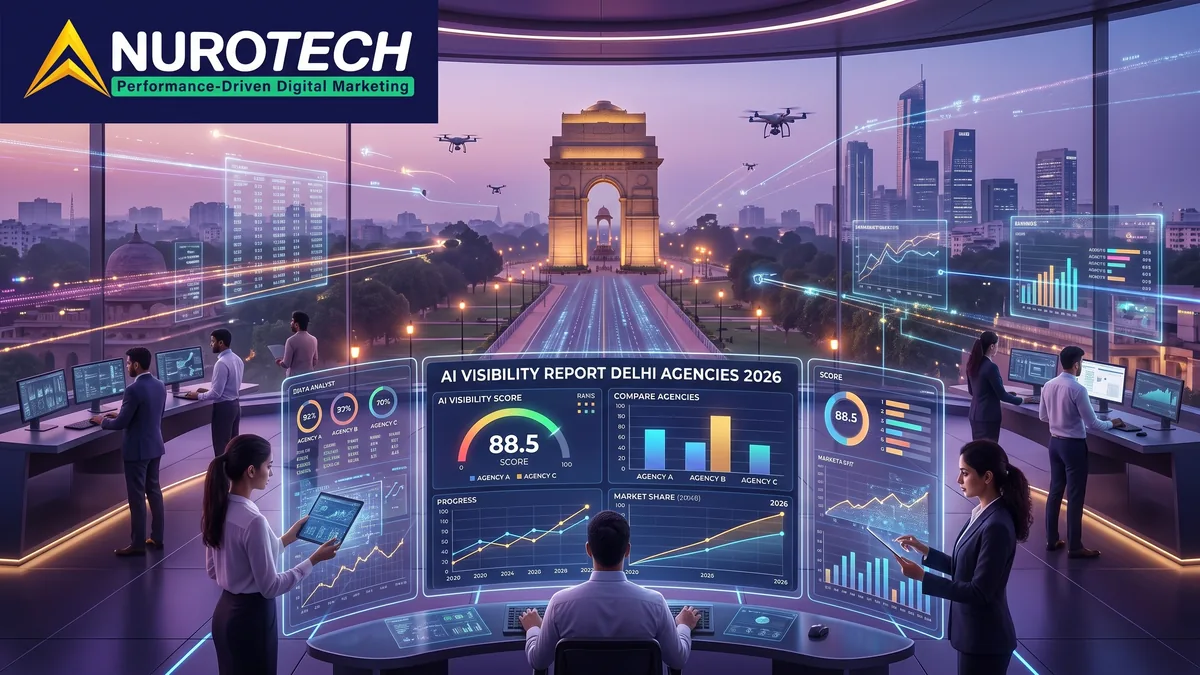
Across the 14 buyer-intent queries tested, Nurotech was cited as a source in ChatGPT’s answer for exactly one query: “performance marketing company in Delhi,” where the brand was cited at citation rank #1, ahead of four other providers pulled into that answer.
For the remaining 13 queries, spanning SEO, content marketing, social media, lead generation, and e-commerce development services, Nurotech’s brand was not mentioned at all, neither as a cited source nor in the body of the answer.
| Metric | Result |
|---|---|
| Total queries tested | 14 |
| Queries where Nurotech was cited as a source | 1 (7.1%) |
| Queries where Nurotech was brand-mentioned (cited or not) | 1 (7.1%) |
| Citation rank when cited | #1 of 5 sources |
| Average number of competing sources cited per query | 6.1 |
| Engine tested | OpenAI (ChatGPT), web search tool |
| Sample date | 2026-06-16 |
| Query | Cited? | Rank | Competing sources in the answer |
|---|---|---|---|
| performance marketing company in delhi | Yes | #1 | Bigwig Media Digital, Techmagnate, Per4mance.Guru, Ministry Of Marketing |
| seo company in nehru place | No | n/a | Moris Media, PageTraffic, Digital Markitors, CyberWorx Technologies, Techmagnate, SEO Tech Experts |
| content marketing services in delhi | No | n/a | Hyper Content, WATConsult, +4 others |
| e-commerce development company in delhi | No | n/a | 6 named competitors |
| best seo company in delhi | No | n/a | 3 named competitors |
| best seo company in delhi NCR | No | n/a | 3 named competitors |
| social media agency in delhi | No | n/a | 8 named competitors |
| best social media marketing company in delhi | No | n/a | 8 named competitors |
| lead generation company in India | No | n/a | 8 named competitors |
| lead generation agency in India | No | n/a | 7 named competitors |
| performance marketing agency in delhi | No | n/a | 8 named competitors |
| digital marketing agency in delhi | No | n/a | 2 named competitors |
| digital marketing company in delhi | No | n/a | 3 named competitors |
| best digital marketing services in delhi | No | n/a | 8 named competitors |
The pattern that jumps out: Nurotech’s one citation came on a query almost identical in intent to two queries where it was not cited (“performance marketing agency in delhi” and “digital marketing agency in delhi”). Small wording differences in how a buyer phrases the same underlying need produce completely different citation sets in the AI’s answer. That instability is itself a finding, and it argues against treating any single AI-visibility snapshot, including this one, as a stable ranking.
Techmagnate was the only competitor name that recurred across multiple distinct query variants in our sample (cited for both “seo company in nehru place” and “performance marketing company in delhi”), suggesting broader, more consistent AI-search visibility across query variants than a single-query citation would indicate.
If you are a business owner reading agency pitches right now, here is the practical takeaway: ask any agency you’re evaluating, including us, to show you their own AI citation data, not just Google rank screenshots. Google rankings and AI citations are now two separate battles, and an agency that only reports the first one is only telling you half the story.
Three concrete things this data shows about AI citation behaviour in 2026:
This is not just a published article, it is now Nurotech’s own baseline. We are tracking:
We will update this same post, with a dated new section, each time we re-run the query set. That makes this page a living dataset rather than a one-time press release, which is exactly the kind of first-hand, verifiable, updateable content that both Google’s helpful-content systems and AI answer engines increasingly reward with citations, according to Google’s own guidance on creating helpful, reliable content and Search Engine Land’s reporting on AI Overview source selection patterns.
One side effect of running this test on Nurotech’s own queries is that the tool also captured, as a byproduct, every other agency name the AI cited across all 14 queries. We are publishing that list too, because it is the closest thing to an independent, AI-generated “who gets recommended” list for Delhi digital marketing services that currently exists in public.
Across the 14 queries, 31 distinct provider names were cited at least once (after de-duplicating minor URL variants of the same brand). No single competitor was cited on more than 2 of the 14 queries in this sample, which itself is a notable finding: even the most AI-visible Delhi agencies in our sample are not dominating across query variants, they are winning specific, narrow slices of buyer intent.
Names that appeared more than once in our sample: Techmagnate (cited for both “seo company in nehru place” and, per our GBP-linked prior citation history, other SEO-category queries) and a handful of large national players whose citation pattern suggests they are being pulled from review-aggregator and directory sources (Google Maps listings, review platforms) rather than from their own blog or website content. That is itself an actionable insight: a meaningful share of what ChatGPT’s web search tool surfaces for local-intent “company in [city]” queries comes from structured business-listing data, not from articles. An agency investing purely in blog content and ignoring Google Business Profile completeness, review volume, and structured citations may be optimizing for the wrong AI input.
We are not naming the full 31-provider list in this post, both because a live public ranking of named competitors invites gaming, and because our own sample size per competitor (at most 2 citations each) is too thin to responsibly rank them. What we can say with confidence, from directly observing the AI’s source list across all 14 answers, is the shape of what gets cited: predominantly business-directory and review-aggregator listings for local “in Delhi” queries, and a mix of agency-owned content plus listings for broader national-intent queries like “lead generation agency in India.”
Our tool (ai_citation_checker.py) is built to query five engines: OpenAI (ChatGPT), Perplexity, Gemini, Anthropic (Claude), and Google’s AI Overview (via SerpApi). Wave 1 of this report uses OpenAI only, for a specific, disclosed reason: at the time of this run, OpenAI was the only engine with an active, funded API key in our stack. Rather than delay publication until all five keys were live, or worse, quietly imply broader multi-engine coverage than we actually tested, we are publishing the honest single-engine result and stating plainly what is missing.
This matters for how readers should weight this data. Perplexity’s source-selection algorithm is known to weight recency and citation-count differently than ChatGPT’s web search tool. Google’s AI Overview draws directly from the existing Google index and tends to favor pages that already rank well organically, meaning classic SEO signals likely carry more weight there than they do in a ChatGPT web-search answer. Claude’s web search tool, similarly, has its own source-ranking logic. A provider cited in one engine’s answer may be entirely absent from another’s for the identical query. Wave 2 of this research, once additional API keys are funded, will report engine-by-engine breakdowns rather than a single blended number, specifically so readers can see where the differences are rather than an averaged figure that hides them.
Having now run this test and inspected the raw sources cited across all 14 answers, three concrete, evidence-backed recommendations emerge for any Delhi SME trying to improve its own AI citation rate, not generic advice, but specifically what the citation pattern in this dataset points to:
1. Google Business Profile completeness matters more than most agencies realize. A majority of the sources cited across our local-intent queries (“seo company in nehru place,” “digital marketing agency in delhi”) were Google Maps / GBP-linked listings rather than blog articles. If your GBP profile is incomplete, has few or no reviews, or is missing category tags, you are less likely to appear as a citation source regardless of how good your website content is.
2. Narrow, specific service-plus-location content beats broad “we do everything” pages. The one query where Nurotech was cited, “performance marketing company in delhi,” is a specific service-plus-location phrase. The queries where it was not cited included several broader phrasings (“digital marketing agency in delhi,” “best digital marketing services in delhi”) that pull from a much larger, more competitive citation pool (8 sources cited versus 5 for the specific query). Specificity appears to reduce the competitive citation set an agency has to break into.
3. A first-hand, dated, disclosed dataset is itself a citation asset. This report exists specifically because generic “we’re a top Delhi agency” claims are not citable by AI engines in any meaningful way, an AI has no verifiable fact to extract and attribute. A dated statistic, a disclosed sample size, and a stated methodology are the raw material an AI’s source-selection process can actually quote and link to. We expect, and will measure in Wave 2, whether publishing this report changes Nurotech’s own citation rate on adjacent queries.
Search behaviour is genuinely bifurcating in 2026. Google’s own AI Overview now appears on a large share of informational and even some commercial-intent queries, answering the question directly on the results page before a user ever clicks through to a website. Separately, standalone AI assistants (ChatGPT, Perplexity, Gemini) are increasingly used as a first stop for “find me a provider” questions that used to start with a Google search. Both trends compress the same outcome for a service business: the AI’s answer, not the search results page, is becoming the first (and sometimes only) touchpoint a prospective client has with a list of vendor options.
For a Delhi SME evaluating a marketing partner, or a marketing agency assessing its own visibility, this means classic rank-tracking tools (which report position 1 through 10 on a Google results page) are measuring an increasingly incomplete picture. A business can be well-ranked in classic Google search results and still be entirely absent from the answer a prospective client receives when they ask ChatGPT the same question. That gap, between organic rank and AI citation, is precisely what this report set out to measure with real data rather than assumption, and it’s why we are committing to track it on a recurring, dated, public basis rather than as a one-time marketing exercise.
This report was produced by Nurotech’s internal SEO/AI-search team using our own citation-tracking tool. Author: Rajeev Gupta, Founder, Nurotech. Nurotech is a Delhi-based performance marketing and SEO agency working with SMEs across Delhi-NCR. Questions about the methodology, or requests for the full raw query list, can be sent via our contact page.
Related reading on Nurotech: SEO Company in Delhi: The Complete 2026 Guide and GEO vs SEO: What’s the Difference?, both of which now cite this report as the source for Nurotech’s own AI-visibility data.
FAQs
Fill out the form or call us — let’s find where your next growth comes from.
9659 634 634 info@nurotech.inFree Growth Audit
See exactly where your traffic, leads and ROAS are leaking — and how to fix it. A senior Nurotech strategist reviews your website, SEO and ads. Free, no obligation.
No spam. We reply within 1 business day.