
Agency Insights
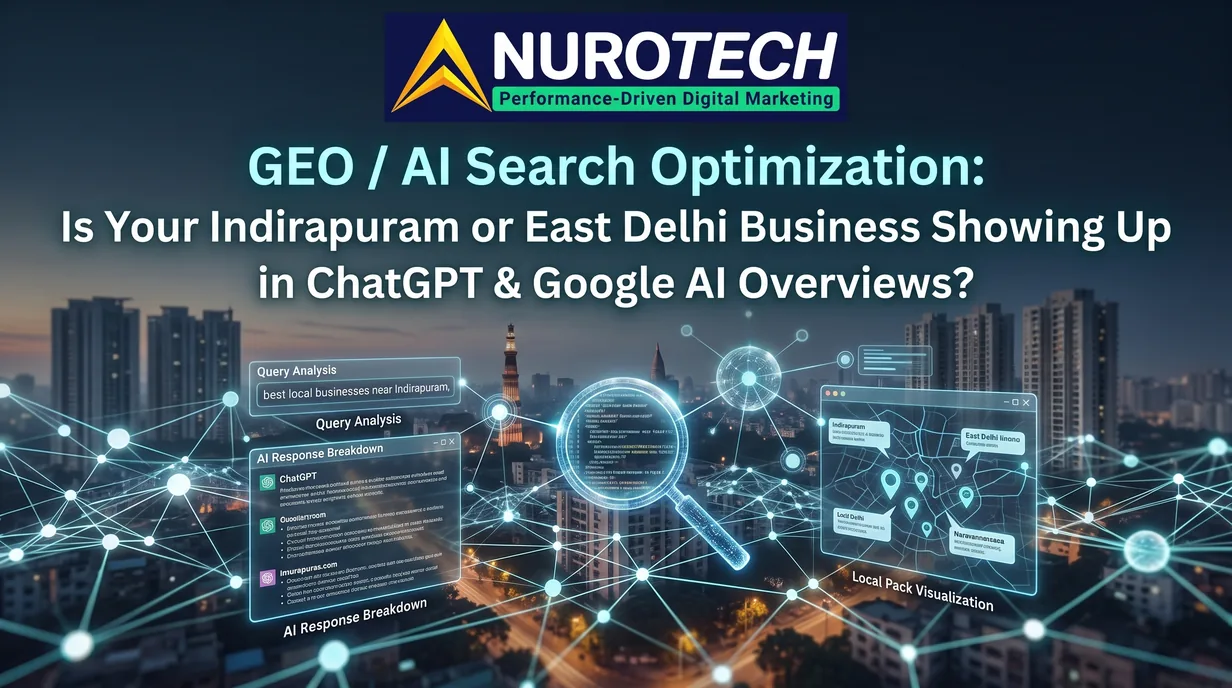
Ask ChatGPT "best digital marketing agency in Indirapuram" or "who does SEO in East Delhi" today, and there's a real chance your business doesn't show up at all — even if you rank on page 1 of Google. That is not a bug. AI answer engines like ChatGPT, Google AI Overviews, and Perplexity don't simply mirror the traditional search results local businesses have spent years chasing. They read the web differently, cite sources differently, and reward a different kind of content structure. For a clinic in Vaishali, a boutique in Preet Vihar, or a real estate broker in Vasundhara, this is no longer a future problem — it is happening in live customer searches right now.
This guide breaks down what GEO (Generative Engine Optimization) and AI search optimization actually mean, how ChatGPT, Google AI Overviews, and Perplexity decide which businesses to cite, and the concrete steps an Indirapuram or East Delhi business owner can take this month — without hiring a national agency or rebuilding a website from scratch.
GEO stands for Generative Engine Optimization — the practice of structuring your business's online presence so AI systems can find it, understand it, and cite it in a generated answer. Some people call this AEO (Answer Engine Optimization) or AI SEO. The terms overlap enough that the exact label doesn't matter much; what matters is the shift in behaviour it describes.
Traditional SEO optimizes for a ranked list of ten blue links. A user searches, sees your listing, and clicks through to your site. AI search optimization is about something different: getting referenced inside an AI-generated answer that the user may never click past. When someone asks ChatGPT "which dermatologist in Indirapuram takes evening appointments," the model doesn't show ten links — it picks two or three sources, synthesizes an answer, and (on platforms that cite sources) shows where the information came from. If your clinic isn't one of those sources, you don't exist in that conversation, regardless of how well your website ranks on Google's tenth page.
We wrote about the broader distinction between the two disciplines in our GEO vs SEO comparison guide — the short version is that SEO gets you ranked, GEO gets you cited, and in 2026 a serious local business needs both running at the same time, not one instead of the other.
We work with businesses across this exact corridor — Indirapuram, Vaishali, Kaushambi, Vasundhara on the Ghaziabad side; Preet Vihar, Mayur Vihar, Anand Vihar, Vivek Vihar, Karkardooma on the East Delhi side — and a pattern shows up consistently: local search behaviour here has shifted faster toward conversational, AI-assisted queries than the national averages suggest. A resident in Shipra Suncity typing "good orthodontist near me open on Sunday" into ChatGPT or Google's AI Mode is not an edge case anymore. It's a Tuesday.
The problem is that most local business websites in this market were built for a search engine that ranks pages, not for an AI system that extracts facts. A homepage with a hero banner, a service list, and a contact form buried at the bottom gives a traditional crawler enough to index and rank — but it gives an AI system almost nothing concrete to quote. No clear service descriptions, no pricing ranges, no specific service-area callouts, no structured data telling the AI "this business operates in Indirapuram and Vaishali, offers X, Y, Z, and here's what makes it different." That gap is exactly where local competitors who fix it first pull ahead — not because their product is better, but because their site is legible to the systems customers are now asking.
These three platforms don't work the same way, and treating "AI search" as one monolithic thing is the most common mistake we see local business owners make when they start thinking about this.
Google has been explicit about this in its own AI features optimization guide: AI Overviews are rooted in the same core Search ranking and quality systems as regular results. There is no separate AI Overview ranking algorithm to game. A page has to be indexed and eligible to appear with a snippet in standard Google Search before it can appear in an AI Overview at all — noindexed pages, pages blocked by robots.txt, and pages with thin or duplicate content never get considered, no matter how well-written the content is. In practice, this means the foundation for AI Overview visibility is the same foundation as good traditional local SEO: clean indexing, genuine E-E-A-T signals, and content that actually answers what people are asking.
ChatGPT pulls from a wider net than "whoever ranks #1 on Google." It draws from live web search results and weighs extractable structure heavily — clear headings, direct answer blocks near the top of a page, comparison tables, and FAQ sections that read like the actual questions people type into a chat box. A page buried in marketing fluff with the real answer three scrolls down performs worse here than a page that states the fact plainly in the first two sentences of a section, even if that page has fewer backlinks.
Perplexity always cites its sources, and it visibly favours content that is authoritative, recently updated, and well-structured — it will pull from Reddit threads, review sites, and Wikipedia as readily as from a business's own domain when those sources answer the question more directly. For a local business, this means your own site competing purely on domain authority is not enough; a well-managed Google Business Profile, genuine customer reviews, and mentions on trusted local directories all feed into what Perplexity is willing to cite alongside (or instead of) your homepage.
Across all three, one thing is consistent: AI systems generate several related queries behind the scenes for a single user question — a pattern Google calls query fan-out. Someone asking "best digital marketing agency near Indirapuram" may trigger the AI to also check pricing, reviews, service specifics, and comparisons with nearby competitors, then synthesize across all of it. A site that only answers the one headline query narrowly is retrieved less often than one that comprehensively covers the topic cluster — pricing, process, service area, differentiators — in one place.
None of this requires a six-figure rebuild. Most of what moves the needle for a local business in this market is fixable within a few weeks.
Every important page and service description should state the direct answer in the first two or three sentences, in plain language, before any brand-voice framing. If a page is about teeth whitening in Indirapuram, the first paragraph should say what it is, roughly what it costs, and who it's for — not open with "Welcome to our world-class smile transformation journey." AI systems extract the first clear, self-contained statement they find; bury it, and it doesn't get pulled.
LocalBusiness schema with accurate NAP (name, address, phone) data, service-area markup, and — where genuinely relevant — FAQPage schema gives AI crawlers a machine-readable version of exactly the facts they need. Google restricted the FAQPage rich snippet to government and health sites back in 2023, so don't expect a visible SERP box from it anymore — but the vocabulary still works as a clean, structured signal for AI systems parsing your page, which is a defensible reason to keep using it even without the old visual payoff.
This is the single highest-leverage step for hyperlocal AI queries ("near me," "in Indirapuram," "open now"). An accurate, regularly updated GBP with correct categories, real photos, and a steady stream of genuine reviews feeds both Google's AI Overviews and, indirectly, ChatGPT and Perplexity when they cross-reference local listings. We cover the multi-location version of this in detail in our GBP optimization guide for East Delhi & Ghaziabad businesses, but even a single-location business benefits from the same discipline: consistent NAP, real category selection, and responding to every review.
AI platforms consistently cite third-party sources — review sites, directories, local news mentions, forum threads — more heavily than a business's own marketing copy. Getting listed accurately on JustDial, Sulekha, Practo (for healthcare), and industry-specific directories, and earning a handful of detailed, specific customer reviews (not generic five-star one-liners) does more for AI citability than another paragraph of homepage copy.
Recency is a real signal across all three platforms. A pricing or service page last updated in 2023 reads as stale to an AI system cross-checking currency of information. Revisit core service pages at least twice a year, update the visible "last updated" date where your CMS supports it, and refresh any numbers (pricing, turnaround time, service areas) that may have changed.
A surprising number of local business sites, especially ones migrated between platforms, end up with overly broad Disallow rules that accidentally block GPTBot, PerplexityBot, ClaudeBot, or Google-Extended. If these are blocked, the platform physically cannot crawl or cite you — no amount of content quality fixes it. This is a five-minute check worth doing before anything else on this list.
Because of query fan-out, a page that only answers "what does SEO cost" narrowly loses to a page that also covers what's included, how long results take, and how pricing compares across service tiers — all in one place. Build pages around the full set of questions a customer (or the AI answering on their behalf) is actually likely to ask, not just the one exact-match keyword phrase.
Generic advice about GEO usually stops at "add schema and write clear answers." For a business in this corridor, there's a layer beneath that: geographic precision matters more here than in a single-city market, because Indirapuram, Vaishali, Kaushambi, and Vasundhara sit close enough together that AI systems (and Google's local algorithm underneath them) have to disambiguate between near-identical service areas constantly.
A business that only says "serving Ghaziabad" is giving an AI system almost nothing to work with when the actual query is "gym near Shakti Khand" or "electrician in Nyay Khand." Naming the specific sub-locality — Shakti Khand, Nyay Khand, Ahinsa Khand, Shipra Suncity on the Indirapuram side; Kaushambi, Vasundhara Sector 9-16, Sahibabad on the wider Ghaziabad side; Preet Vihar, Karkardooma, Vivek Vihar on the East Delhi side — in service pages, GBP categories, and FAQ answers gives both traditional local search and AI answer engines the exact granularity they're trying to match a "near me" query against.
The same logic applies to East Delhi's specific commercial character. Nehru Place-adjacent IT and electronics traders, for instance, get searched very differently than a Preet Vihar boutique clinic — different vocabulary, different urgency, different AI fan-out queries. We saw this directly while researching our Nehru Place IT & electronics SEO guide: the AI-relevant queries in that niche were almost entirely about specific product availability and warranty terms, not the generic "best electronics shop" phrasing a template SEO checklist would assume.
This is also why we've moved our own build stack toward faster, more AI-legible architecture rather than staying on a traditional WordPress setup — the technical foundation genuinely affects how cleanly an AI crawler can parse a page. We go into the reasoning in why Ghaziabad businesses are switching to AI-search-ready sites, and it's a first-hand account of trade-offs we made on our own site, not a theoretical pitch.
Most Indirapuram or East Delhi business owners don't need a full AI SEO overhaul on day one. A realistic sequence looks like this: in the first two to three weeks, audit and fix robots.txt access, verify GBP accuracy across every location, and rewrite the top three or four highest-traffic service pages to lead with a direct, answer-first paragraph. In weeks four through eight, add LocalBusiness and FAQPage schema across the site, build out a genuine FAQ section grounded in real customer questions (not guessed keywords), and start a light cadence of directory and review-building activity. By week ten to twelve, most businesses in this corridor start seeing early signs of AI citation — showing up in a ChatGPT answer for a service-plus-locality query, or appearing as a source link in a Perplexity result — though it's worth being honest that this is directionally slower and less measurable than traditional rank tracking, since none of these platforms offer a Search Console equivalent yet.
A few patterns repeat often enough across Indirapuram and East Delhi businesses that they're worth calling out directly. The first is treating AI search optimization as a one-time project rather than an ongoing discipline — a business fixes its schema markup and GBP once, then leaves it untouched for a year while competitors keep refreshing theirs. AI systems weight recency; a static profile slowly loses ground even without anything going technically wrong.
The second is writing FAQ sections around what the business wants to be asked rather than what customers actually type. A dental clinic's real FAQ traffic is "does it hurt," "how much for a filling," "do you take walk-ins on Sunday" — not "what makes our clinic different" phrased as a question. Pull real questions from WhatsApp chats, phone call logs, and Google Business Profile Q&A before writing the FAQ block; guessed questions read as generic to both readers and AI systems, and generic content is exactly what gets passed over in favour of a more specific competitor.
The third mistake is chasing every AI platform equally when the actual customer base skews heavily toward one channel. A B2B service in the Nehru Place electronics and IT corridor gets far more value optimizing for how ChatGPT and Perplexity handle detailed technical and pricing queries than chasing Google AI Overview visibility for broad consumer terms. A neighbourhood clinic or salon, on the other hand, gets most of its AI-driven discovery through Google's own AI Mode and Overviews, tied tightly to Google Business Profile data. Knowing which platform your actual customers use to ask these questions should decide where the first month of effort goes, not a generic checklist that treats all three platforms as equally important for every business type.
Google's own guidance is refreshingly blunt on this point: there is no special markup or secret trick that guarantees AI citation, and content written specifically and only "for the AI" rather than for people risks being treated as scaled content abuse. The businesses in this market that will actually benefit from GEO are the ones doing genuinely helpful, specific, locally-grounded content and structure work — not the ones chasing a shortcut. If a page wouldn't satisfy an actual Indirapuram resident reading it, it's not going to satisfy the AI system standing in for them either.
GEO is not a replacement for SEO — it's an addition. Google AI Overviews are built on the same core ranking and indexing systems as regular Search, so traditional SEO fundamentals (indexing, E-E-A-T, page experience) remain the foundation. ChatGPT and Perplexity add a further layer on top, rewarding extractable structure and third-party citability that traditional SEO doesn't always prioritize.
Ask ChatGPT, Perplexity, and Google (with AI Mode/AI Overviews) the exact questions your customers would ask — "best [service] in Indirapuram," "[service] near Vaishali," and similar — and note whether your business is mentioned or cited. Do this for 8-10 realistic queries rather than one, since results vary by phrasing.
Yes, indirectly. Google restricted the FAQPage rich result to government and health sites in 2023, so most commercial sites won't get the old expandable SERP box back. But the structured Q&A data is still a clean, machine-readable signal that AI systems parsing your page for citable facts can use — it's worth keeping for that reason even without the SERP visual.
Most businesses in this corridor see early signs — appearing as a cited source in a ChatGPT or Perplexity answer — within 8-12 weeks of consistent work: fixed crawler access, updated GBP, answer-first content, and schema markup. It's generally slower to measure than traditional rank tracking because none of the major AI platforms offer a Search Console-equivalent reporting tool yet.
No. Most of the highest-impact fixes — answer-first content structure, GBP accuracy, schema markup, robots.txt access, third-party review presence — can be layered onto an existing site. A full rebuild only becomes worthwhile if the current site has deeper technical issues (very slow load times, broken indexing, JavaScript-heavy content the crawler can't parse at all).
Indirapuram, Vaishali, Kaushambi, and Vasundhara sit close enough together that both Google's local algorithm and AI answer engines need precise signals to match a "near me" query to the right business. A page or GBP listing that only says "Ghaziabad" gives the system far less to match against than one that names the actual sub-locality a customer is searching from.
Yes — arguably more easily than on traditional SEO, because AI citation rewards specificity and genuine local grounding over raw domain authority. A business with detailed, locality-specific content and a well-managed Google Business Profile can out-cite a bigger competitor whose site is generic and thin on real local detail.
That's a genuine trade-off, not a simple yes/no. Blocking GPTBot, ClaudeBot, or PerplexityBot prevents both training use and citation — you can't have one without the other on most of these bots. A common middle ground is blocking training-only crawlers like CCBot while leaving the search-facing bots (GPTBot, PerplexityBot, Google-Extended) open, since those are the ones that actually drive citation and referral traffic.
FAQs
Fill out the form or call us — let’s find where your next growth comes from.
9659 634 634 info@nurotech.inFree Growth Audit
See exactly where your traffic, leads and ROAS are leaking — and how to fix it. A senior Nurotech strategist reviews your website, SEO and ads. Free, no obligation.
No spam. We reply within 1 business day.